Introduction
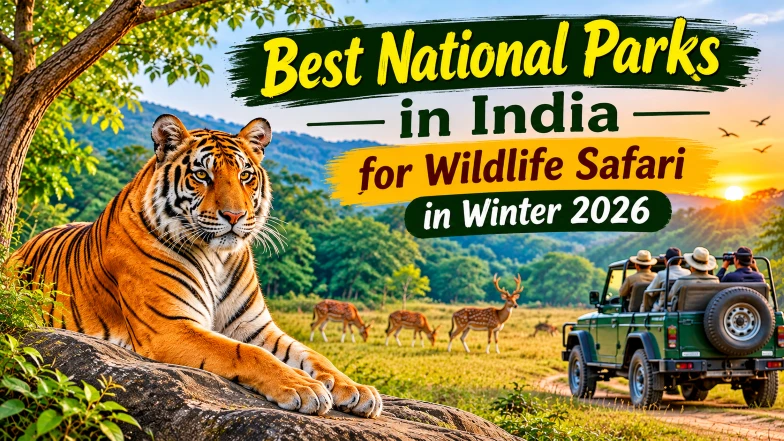
“National parks in India for wildlife safari offer some of the most exciting wildlife experiences in the world, and winter is the best time to visit them. From November to February, early mornings are crisp, the forest is less dense and the tigers, rhinos, lions and leopards wander out in the soft golden morning light. This guide shows you where to go if you are planning a trip in Winter 2026.”
This pillar guide explains why winter is a great time, the quick park-picker, 10 best places for wildlife in India in depth, and much much more to help you book, pack and travel responsibly. For those of you who want to see your first tiger or are looking for an elusive bird, there’s a park here for you!
Why Winter Is the Best Season for a Wildlife Safari in India
In a nutshell, India is the ideal place to go on a safari in the winter months.
India is indeed the golden window for wildlife tourism in the winter months and there are good reasons for this.
- Parks are open and at full capacity. The majority of core areas are shut down during the monsoon and safaris are at their peak and best in the winter months.
- Animals can be more easily seen. Dry grass and less vegetation makes it easier to spot animals, cool days move them to waterholes, clearings, and sunny forest roads.
- Weather is comfortable. Most parks have pleasant daytime temperatures and so driving and photography is less strenuous in the hot summer weather.
- Birdlife peaks. Tigers are an ideal subject to watch in the wild, but don’t be surprised to see colourful birds join the inhabitants of the forest.
- Landscapes are in their best condition. The clear skies, misty sunrises and golden afternoons are the type of light that photographers wait all year for!
Just one word to the wise: in northern and central India, open jeeps become very cold in the morning, so warming up is important. Permits and lodges are also in high demand in the winter. Make your bookings once they are confirmed.
Planning a longer trip around your safari? Explore the best places to visit in India in December 2026 to add beaches, hill stations and festivals to your itinerary.
Quick Guide: Which National Park Should You Choose?
Need some help getting started? Use this snapshot to compare a park to your wildlife list!
Park | State | Star attraction | Best for |
Jim Corbett | Uttarakhand | Tigers, elephants | For beginners, safaris and forest lodging will be the initial experiences. |
Ranthambore | Rajasthan | The tigers are close to the ancient ruins. | Photography, daylight sightings. |
Bandhavgarh | Madhya Pradesh | Dense tiger population | Serious tiger tracking |
Kanha | Madhya Pradesh | Tigers, barasingha | Meadows, views and families. |
Pench | Madhya Pradesh–Maharashtra | Tigers, wild dogs | Quiet, uncrowded safaris |
Tadoba-Andhari | Maharashtra | Tigers, sloth bears | Reliable sightings |
Kaziranga | Assam | One-horned rhinos | Rhino and elephant-back views. |
Gir | Gujarat | Asiatic lions | The only wild lions in Asia |
Sundarbans | West Bengal | Mangrove tigers | Boat safaris and adventure. |
Nagarhole and Kabini | Karnataka | Elephants, leopards | Wildlife in the Backwater in the southern part of the Indian subcontinent. |
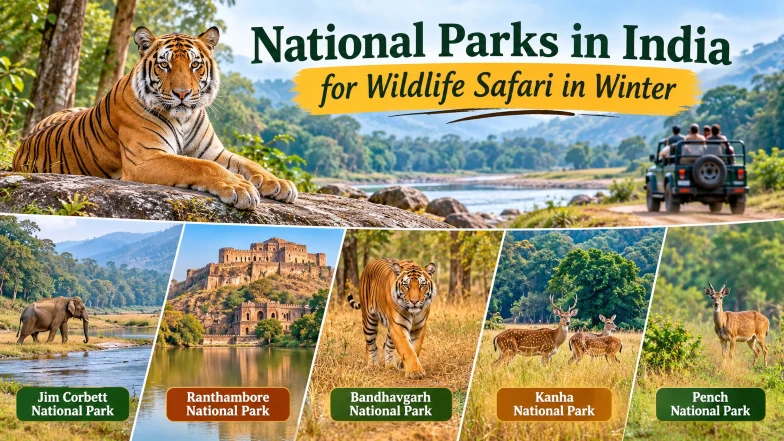
1. Jim Corbett National Park, Uttarakhand: The Beginning of India’s Tiger Story
Corbett became India’s first National Park in 1936 and Project Tiger was started in 1973 there. Its topography consists of a blend of the foothills of the Himalayas, sal forest, grassland and the shimmering Ramganga river. Elephants come to the river banks, gharials to the sandy shores and hundreds of bird species to the wetlands in the winter.
There are several different moods in the safari zones, Bijrani, Dhikala, Jhirna and Durga Devi. The forest rest houses at Dhikala are usually opened in mid-November and are the ideal place to stay in the park. Mornings are cold and sometimes misty, pack accordingly. Corbett is about 240 km away from Delhi and thus it is a hassle-free long weekend holiday.
2. Ranthambore National Park, Rajasthan: Tigers Among Royal Ruins
There are hardly any places in India as dramatic as Ranthambore. Tigers are active during the day here, and walk by crumbling palaces, stepped lakes, and the 10th century Ranthambore Fort, which is part of a UNESCO World Heritage listing for the Hill Forts of Rajasthan.
The park is zoned and site areas around the lake like Padam Talao and Rajbagh are popular haunts. Also, find leopards, sloth bears, marsh crocodiles and an abundance of peacocks apart from tigers. This is a perfect park for photographers in winter as the days are sunny and dry. The entry point is Sawai Madhopur station, making it easy to get to the park by train.
Visiting Rajasthan this season? Combine your tiger safari with forts, palaces and desert camps by reading our guide to the best places to visit in Rajasthan in winter.
3. Bandhavgarh National Park, Madhya Pradesh: For Serious Tiger Spotters
Bandhavgarh is renowned for having one of the highest densities of tigers in the country, making it a fantastic opportunity to plan your visit. It is a small, rugged, hilly park, with caves and an ancient fort standing above the trees.
The most popular zone is Tala; Magadhi and Khitauli are lucrative alternatives with lesser vehicles. Apart from the tigers you can also see the leopard, gaur, spotted deer, jackal and many species of raptors. Mornings are cold in winter, but the cold prevents animals from becoming inactive. Bandhavgarh is an ideal companion of Kanha and can be travelled together in a circuit around central India.
4. Kanha National Park, Madhya Pradesh: The Jungle Book Landscape
Kanha’s extensive sal forests and open meadows are associated with the setting of Kipling’s The Jungle Book and it is true to the legend. The Park is also well known for having saved the hard-ground barasingha (Rucervus duvaucelii branderi), a rare swamp deer, from near extinction.
There are zones with different terrain, such as Kisli, Kanha, Mukki, etc. and meadows where you can spot tigers, the gaur, wild dogs and chital herds. The sunset viewpoint is called Bamni Dadar, which is a beautiful place to watch the sunset. With its spacious and open environment, Kanha is also a wonderful place for the whole family to visit, as it allows for easy and enjoyable spotting opportunities for wildlife.
5. Pench National Park, Madhya Pradesh and Maharashtra: Quiet and Underrated
Straddling two States, Pench is named after the river that runs through the teak forest and rocky ridges. It’s another landscape that’s associated with Mowgli’s story and it’s known for the Collarwali tigress, the legendary mother who raised dozens of cubs over her lifetime.
Peaceful drives and more personal experience are characteristics of Pench as it tends to be less populated as compared to its famous neighbours. Wild dogs, sloth bears, leopards and tigers are common around the Totladoh reservoir with plenty of birdlife to be seen. If you are looking for a quieter forest environment than gates, Pench is a must on your list.
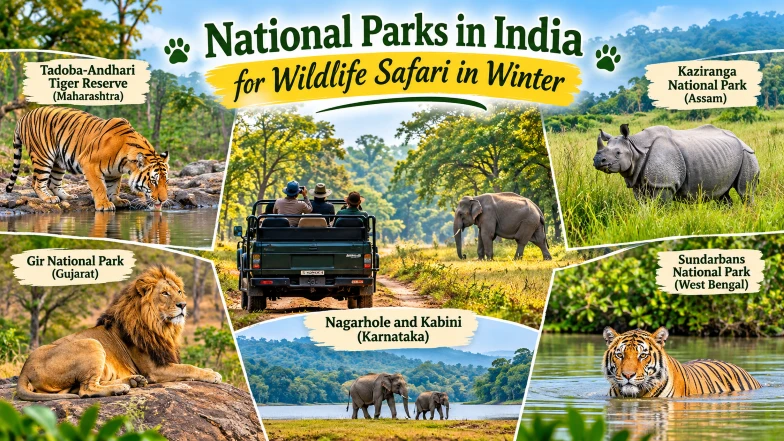
6. Tadoba-Andhari Tiger Reserve, Maharashtra: Reliable Sightings, Raw Beauty
Tadoba is Maharashtra’s oldest and largest National Park which has earned a great reputation for consistent sightings of tigers. The teak forests, bamboo thickets and sparkling lakes provide the perfect backdrop for a classic Central Indian scene, and it is common to find tigers cooling off at the water’s edge.
Entry points include Moharli, Kolara, Navegaon and Pangdi with core and buffer areas providing safaris. Look out for sloth bears, wild dogs, leopards and marsh crocodiles, apart from the tigers. The closest big city is Nagpur, about 140 km away, hence Tadoba is ideal for a short winter vacation.
7. Kaziranga National Park, Assam: Land of the One-Horned Rhino
Kaziranga is a UNESCO World Heritage Site and home to most of the world’s greater one-horned rhino. The magnificent Brahmaputra flood plain, wetlands and tall elephant grass offer a scene of a kind never seen in India. The park opens to visitors from November in general when the monsoon floods have subsided.
Each of the ranges offers rhino, wild water buffalo, swamp deer, elephants and significant tiger sightings – Kohora (central), Bagori (western) and Agoratoli (eastern). A rare chance to see the grasslands from a first person perspective is provided by the elephant rides in the early morning, available at certain sites. Mornings in the winter can sometimes be foggy, but once the sun comes up, it makes for a memorable day. Guwahati is the main gateway.
8. Gir National Park, Gujarat: Last Home of the Asiatic Lion
Located in Gujarat, the Gir National Park is home to the last population of the Asiatic lion.
Asiatic lions are found only in the wild at Gir and winter is an amazing time to visit. Dry deciduous forest opens up, lions lie on warm rocks and roads and a cool breeze creates a comfortable game drive.
In addition to lions, Gir is home to leopards, striped hyenas, marsh crocodiles and many types of antelope. Explore the forest villages of the Maldhari community to discover how humans and lions coexist. Make sure to book in advance as there is only a limited number of permits available, and make at least two drives to increase your odds of seeing the lions at Sasan Gir.
9. Sundarbans National Park, West Bengal: Tigers of the Mangrove Delta
Adventure like this can be had nowhere other than the Sundarbans. In this place, safaris are conducted by boat, meandering through a web of tidal creeks and mangrove forests where the renowned Royal Bengal tiger can be spotted swimming between islands. It is a UNESCO World Heritage Site that is shared between India and Bangladesh.
Be realistic: It’s a dense habitat and seeing a tiger is not likely. It’s still an exciting trip, however: the estuarine crocodiles, the monitor lizards, the spotted deer, the fishing cats and an amazing variety of kingfishers and other birds make every cruise memorable. The weather is calm and skies are clear during November – February. The entry is allowed only with permits and majority of visitors join organised tours from Kolkata.
10. Nagarhole and Kabini, Karnataka: South India’s Wildlife Jewel
If you’re looking for a different taste, go south. The Kabini backwaters are surrounded by and within the boundaries of Nagarhole National Park (also called as Rajiv Gandhi National Park), which forms part of the Nilgiri Biosphere Reserve. Elephants gather in great numbers along the shore in the winter and a boat safari allows for quiet close-up views of the reservoir.
Leopards, tigers, gaur, wild dogs and dozens of bird species also inhabit here. This is one of the most beautiful safari destinations in India owing to the nice weather and green environment.
Honourable Mentions for Your Winter Wildlife List
While you have some extra days, take a trip to Satpura (Madhya Pradesh) for walking and boat safaris, Panna (Madhya Pradesh) for tigers and vultures on the Ken river and Periyar (Kerala) for boats cruising around its lake and elephants.
Which Animals Can You See on a Winter Safari in India?
The national parks are home to an amazing diversity of species and many of them are more likely to be seen in winter.
- Big cats: Bengal Tiger in Corbett, Ranthambore, Bandhavgarh, Kanha, Pench and Tadoba, Asiatic Lions in Gir and leopards in most of the forests.
- Giant herbivores of the grasslands: one-horned rhinos and wild water buffalo of Kaziranga; Asian elephants of Corbett, Kaziranga and Nagarhole.
- Bears and wild dogs: Sloth bears are seen frequently in Tadoba, Pench and Ranthambore and dholes (wild dogs) move in packs in Kanha and Pench.
- Deer and antelope: The meadows are full of deer and antelopes like chital, sambar, barasingha, nilgai, blackbuck and chinkara which make the hunting of tigers possible.
- Reptiles and water life: Gharials, marsh crocodiles and estuarine crocodiles roam the rivers and creeks.
- Birds: Winter is a birdwatcher’s delight with birds such as raptors, kingfishers, storks, owls and migratory ducks.
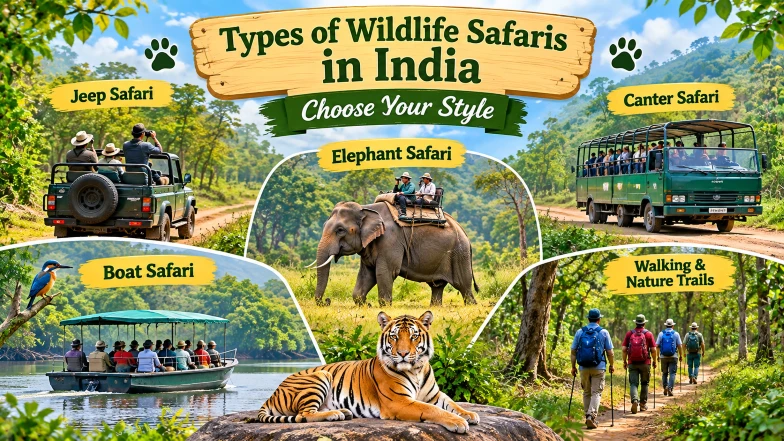
Types of Wildlife Safaris in India: Choose Your Style
India offers a variety of different wildlife safaris, each with its own unique style.
The proper safari format can make the difference in how your safari will go, so go with what you’re interested in and what you feel at ease with.
- Jeep safari: It is the most popular safari mode. They are small open vehicles that will transport up to six guests, are swift and can reach quieter parts of the forest.
- Canter safari: One of the more recent developments is the Canter safari, which consists of larger open vehicles that are utilized in certain parks. They are less expensive, less versatile, and typically are more overcrowded.
- Elephant safari: Provided in some parks like Kaziranga, typically in the early morning. Availability is subject to local rules.
- Boat safari: In the Sundarbans, it is mandatory, and at Kabini and Periyar, a gorgeous boat safari with animals right by the water’s edge.
- Walking and nature trails: Only permitted in certain areas (buffer zones and some parks) and with an authorised guide.
Wildlife Conservation in India: Why Your Visit Matters
The lion’s share of the world’s wild tigers reside in India, and that is a decades-long effort. Project Tiger was launched in 1973 and established protected areas, enhanced anti-poaching initiatives and introduced methods to coexist with wildlife in the forest. Rhinos also have made a comeback in Kaziranga, and lions in Gir, the result of committed conservation efforts.
By purchasing a safari permit, you are also contributing to the people and forest departments that help to conserve these habitats, when you book a stay at a responsible lodge or hire a local guide. Your vacation is a small, but significant gift to the future of India’s wild.
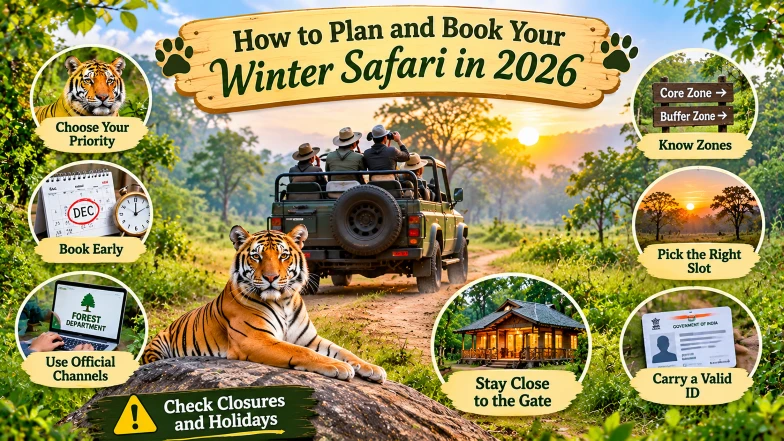
How to Plan and Book Your Winter Safari in 2026
Smart planning is the key to great safaris. Here are steps you can take to avoid disappointment.
- Decide which animal is your priority. Each animal in the quartet of tigers, rhinos, lions and elephants is a pointer to a different park, so choose which park first.
- Make early arrangements for dates. December and the Christmas/New Years’ weeks are the most hectic weeks. Book safaris and lodges as soon as you can.
- Book via official channels. Online booking portals for most of the big parks are run by the State Forest Department. Please check all fees, timing and rules on the official website as they vary with each season.
- Understand zones. Typically, core zones will provide for more abundant wildlife, while buffer zones may be more peaceful and cost-effective. Combining both provides a more comprehensive view.
- Choose the slot that is right for the safari. The most active predators come out early in the day, when the sun is rising. Driving in the afternoon is more pleasant, and much quieter.
- Bring a valid photo ID with you. In most cases, park management will require identification for all guests on the booking.
- Keep close to the gate. Locating lodges near the entry point is an advantage because it saves precious time in the car in the pre-dawn hours.
Make sure to look for weekly closures and area holidays as well. There are days or zones in some parks where they close down safaris and you wouldn’t want to find out after you booked a tour.
What to Pack for a Winter Wildlife Safari
Even with open jeeps, dawn drives may be colder than the forecast, so dress appropriately.
- Warm layers: thermal innerwear, fleece and windproof jacket
- Woollen cap, gloves and scarf for early mornings.
- Neutral colours – green, brown or khaki (no bright colours, strong perfume)
- A comfortable pair of shoes and warm boots.
- Binoculars, camera (with good zoom lens and extra batteries – they drain fast when cold!)
- Sunscreen, a hat and a refillable water bottle with sunglasses.
- First Aid kit, including personal medicines if any.
Wildlife Photography Tips for Beginners
Beautiful images are not only for the professionals. Have your camera handy at all times since there may be short sightings. Capture moving animals with a fast shutter speed, at the soft light of early morning, and shoot the picture on the eyes for emotional portraits. A beanbag fits snugly into the jeep rail and stabilizes long lenses. First and foremost, turn the camera off and enjoy the moment!
Safari Etiquette: How to Travel Responsibly
Respect and visit to the wild places of India keeping them healthy. On each and every drive:
- Sit down and use a low voice so animals are not disturbed.
- Never feed, call out to or chase wildlife.
- Stay at a distance and be guided at all times.
- Collect all plastic and rubbish, no single use.
- Stay at environmentally-conscious lodges that hire local people and abide by forest policies.
Responsible tourism contributes towards conservation, habitat protection and future generations to continue enjoying the magic.
Sample Winter Wildlife Itineraries for 2026
These routes are suggestions and you can modify them to fit your travel time and budget.
- Tiger circuit in central India (approx. 7 nights): 3 nights in Kanha, 3 nights in Bandhavgarh, transfer day between the two. If time permits add Pench or Tadoba.
- Classic of North India (approx. 6 nights): Leave Delhi for Jim Corbett for 2/3 nights, come back to Delhi and then head off for Sawai Madhopur by train where you then head off to Ranthambore.
- North-East rhino escape (approx. 4 nights): Arrive in Guwahati, head to Kaziranga for three nights of safaris in the morning and afternoon along the western and central ranges and visit the local tea gardens.
- Lions and coast (approx 4 nights): visit the temples and coastline; spend 2-3 days on lion safaris in Gir, either from Ahmedabad or Rajkot.
- Mangrove adventure (around 3 nights): Start in Kolkata and book a guided cruise tour in the Sundarbans on water for an extraordinary Safari.
Common Mistakes to Avoid on a Wildlife Safari
Some minor issues can ruin a great travel experience. Avoid these:
- Booking only one safari: wildlife is unpredictable, so make more than one booking and be prepared for the unexpected.
- Expecting a sure-thing tiger: Go and enjoy the whole forest (including birds and butterflies) and the tiger is a plus.
- Bright-colored clothing or perfumes: May distract the animals and detract from sightings.
- Too many cameras, not enough warm clothes: Cold hands don’t shoot, and cold gloves are no fun unless they have a good grip.
- Not accounting for travel time: Long distances between parks can reduce the number of rest days available. Don’t overestimate what you can do.
- Last minute booking: Winter is busy season and popular areas fill up swiftly.
Final Thoughts: Your Winter 2026 Safari Starts Now
The best national parks in India for wildlife safari are more than a list of animals. They are cold misty mornings, the hush before an alarm call and the excitement of a tiger walking onto the road in front of you. Choose the park that is best suited for your dream sighting, reserve and arrive early; pack warm and travel with respect. If you do, then you might have a wildlife experience to remember forever in Winter 2026.
Frequently Asked Questions
The best national parks in India for wildlife safari are at their finest during the winter months and provide some of the most exciting wildlife experiences in the world. In the month of November to February early mornings are crisp, the forest is less dense and the tigers, rhinos, lions and leopards wander out in the soft golden morning light. This guide lets you know where to go if you’re going in Winter 2026.
This pillar guide explains why winter is a great time, the quick park-picker, 10 best places for wildlife in India in depth, and much much more to help you book, pack and travel responsibly. For those of you who want to see your first tiger or are looking for an elusive bird, there’s a park here for you!
Why Winter Is the Best Season for a Wildlife Safari in India
In a nutshell, India is the ideal place to go on a safari in the winter months.
India is indeed the golden window for wildlife tourism in the winter months and there are good reasons for this.
- Parks are open and at full capacity. The majority of core areas are shut down during the monsoon and safaris are at their peak and best in the winter months.
- Animals can be more easily seen. Dry grass and less vegetation makes it easier to spot animals, cool days move them to waterholes, clearings, and sunny forest roads.
- Weather is comfortable. Most parks have pleasant daytime temperatures and so driving and photography is less strenuous in the hot summer weather.
- Birdlife peaks. Tigers are an ideal subject to watch in the wild, but don’t be surprised to see colourful birds join the inhabitants of the forest.
- Landscapes are in their best condition. The clear skies, misty sunrises and golden afternoons are the type of light that photographers wait all year for!
Just one word to the wise: in northern and central India, open jeeps become very cold in the morning, so warming up is important. Permits and lodges are also in high demand in the winter. Make your bookings once they are confirmed.
Quick Guide: Which National Park Should You Choose?
Need some help getting started? Use this snapshot to compare a park to your wildlife list!
Park | State | Star attraction | Best for |
Jim Corbett | Uttarakhand | Tigers, elephants | For beginners, safaris and forest lodging will be the initial experiences. |
Ranthambore | Rajasthan | The tigers are close to the ancient ruins. | Photography, daylight sightings. |
Bandhavgarh | Madhya Pradesh | Dense tiger population | Serious tiger tracking |
Kanha | Madhya Pradesh | Tigers, barasingha | Meadows, views and families. |
Pench | Madhya Pradesh–Maharashtra | Tigers, wild dogs | Quiet, uncrowded safaris |
Tadoba-Andhari | Maharashtra | Tigers, sloth bears | Reliable sightings |
Kaziranga | Assam | One-horned rhinos | Rhino and elephant-back views. |
Gir | Gujarat | Asiatic lions | The only wild lions in Asia |
Sundarbans | West Bengal | Mangrove tigers | Boat safaris and adventure. |
Nagarhole and Kabini | Karnataka | Elephants, leopards | Wildlife in the Backwater in the southern part of the Indian subcontinent. |
1. Jim Corbett National Park, Uttarakhand: The Beginning of India’s Tiger Story
Corbett became India’s first National Park in 1936 and Project Tiger was started in 1973 there. Its topography consists of a blend of the foothills of the Himalayas, sal forest, grassland and the shimmering Ramganga river. Elephants come to the river banks, gharials to the sandy shores and hundreds of bird species to the wetlands in the winter.
There are several different moods in the safari zones, Bijrani, Dhikala, Jhirna and Durga Devi. The forest rest houses at Dhikala are usually opened in mid-November and are the ideal place to stay in the park. Mornings are cold and sometimes misty, pack accordingly. Corbett is about 240 km away from Delhi and thus it is a hassle-free long weekend holiday.
2. Ranthambore National Park, Rajasthan: Tigers Among Royal Ruins
There are hardly any places in India as dramatic as Ranthambore. Tigers are active during the day here, and walk by crumbling palaces, stepped lakes, and the 10th century Ranthambore Fort, which is part of a UNESCO World Heritage listing for the Hill Forts of Rajasthan.
The park is zoned and site areas around the lake like Padam Talao and Rajbagh are popular haunts. Also, find leopards, sloth bears, marsh crocodiles and an abundance of peacocks apart from tigers. This is a perfect park for photographers in winter as the days are sunny and dry. The entry point is Sawai Madhopur station, making it easy to get to the park by train.
3. Bandhavgarh National Park, Madhya Pradesh: For Serious Tiger Spotters
Bandhavgarh is renowned for having one of the highest densities of tigers in the country, making it a fantastic opportunity to plan your visit. It is a small, rugged, hilly park, with caves and an ancient fort standing above the trees.
The most popular zone is Tala; Magadhi and Khitauli are lucrative alternatives with lesser vehicles. Apart from the tigers you can also see the leopard, gaur, spotted deer, jackal and many species of raptors. Mornings are cold in winter, but the cold prevents animals from becoming inactive. Bandhavgarh is an ideal companion of Kanha and can be travelled together in a circuit around central India.
4. Kanha National Park, Madhya Pradesh: The Jungle Book Landscape
Kanha’s extensive sal forests and open meadows are associated with the setting of Kipling’s The Jungle Book and it is true to the legend. The Park is also well known for having saved the hard-ground barasingha (Rucervus duvaucelii branderi), a rare swamp deer, from near extinction.
There are zones with different terrain, such as Kisli, Kanha, Mukki, etc. and meadows where you can spot tigers, the gaur, wild dogs and chital herds. The sunset viewpoint is called Bamni Dadar, which is a beautiful place to watch the sunset. With its spacious and open environment, Kanha is also a wonderful place for the whole family to visit, as it allows for easy and enjoyable spotting opportunities for wildlife.
5. Pench National Park, Madhya Pradesh and Maharashtra: Quiet and Underrated
Straddling two States, Pench is named after the river that runs through the teak forest and rocky ridges. It’s another landscape that’s associated with Mowgli’s story and it’s known for the Collarwali tigress, the legendary mother who raised dozens of cubs over her lifetime.
Peaceful drives and more personal experience are characteristics of Pench as it tends to be less populated as compared to its famous neighbours. Wild dogs, sloth bears, leopards and tigers are common around the Totladoh reservoir with plenty of birdlife to be seen. If you are looking for a quieter forest environment than gates, Pench is a must on your list.
6. Tadoba-Andhari Tiger Reserve, Maharashtra: Reliable Sightings, Raw Beauty
Tadoba is Maharashtra’s oldest and largest National Park which has earned a great reputation for consistent sightings of tigers. The teak forests, bamboo thickets and sparkling lakes provide the perfect backdrop for a classic Central Indian scene, and it is common to find tigers cooling off at the water’s edge.
Entry points include Moharli, Kolara, Navegaon and Pangdi with core and buffer areas providing safaris. Look out for sloth bears, wild dogs, leopards and marsh crocodiles, apart from the tigers. The closest big city is Nagpur, about 140 km away, hence Tadoba is ideal for a short winter vacation.
7. Kaziranga National Park, Assam: Land of the One-Horned Rhino
Kaziranga is a UNESCO World Heritage Site and home to most of the world’s greater one-horned rhino. The magnificent Brahmaputra flood plain, wetlands and tall elephant grass offer a scene of a kind never seen in India. The park opens to visitors from November in general when the monsoon floods have subsided.
Each of the ranges offers rhino, wild water buffalo, swamp deer, elephants and significant tiger sightings – Kohora (central), Bagori (western) and Agoratoli (eastern). A rare chance to see the grasslands from a first person perspective is provided by the elephant rides in the early morning, available at certain sites. Mornings in the winter can sometimes be foggy, but once the sun comes up, it makes for a memorable day. Guwahati is the main gateway.
8. Gir National Park, Gujarat: Last Home of the Asiatic Lion
Located in Gujarat, the Gir National Park is home to the last population of the Asiatic lion.
Asiatic lions are found only in the wild at Gir and winter is an amazing time to visit. Dry deciduous forest opens up, lions lie on warm rocks and roads and a cool breeze creates a comfortable game drive.
In addition to lions, Gir is home to leopards, striped hyenas, marsh crocodiles and many types of antelope. Explore the forest villages of the Maldhari community to discover how humans and lions coexist. Make sure to book in advance as there is only a limited number of permits available, and make at least two drives to increase your odds of seeing the lions at Sasan Gir.
9. Sundarbans National Park, West Bengal: Tigers of the Mangrove Delta
Adventure like this can be had nowhere other than the Sundarbans. In this place, safaris are conducted by boat, meandering through a web of tidal creeks and mangrove forests where the renowned Royal Bengal tiger can be spotted swimming between islands. It is a UNESCO World Heritage Site that is shared between India and Bangladesh.
Be realistic: It’s a dense habitat and seeing a tiger is not likely. It’s still an exciting trip, however: the estuarine crocodiles, the monitor lizards, the spotted deer, the fishing cats and an amazing variety of kingfishers and other birds make every cruise memorable. The weather is calm and skies are clear during November – February. The entry is allowed only with permits and majority of visitors join organised tours from Kolkata.
10. Nagarhole and Kabini, Karnataka: South India’s Wildlife Jewel
If you’re looking for a different taste, go south. The Kabini backwaters are surrounded by and within the boundaries of Nagarhole National Park (also called as Rajiv Gandhi National Park), which forms part of the Nilgiri Biosphere Reserve. Elephants gather in great numbers along the shore in the winter and a boat safari allows for quiet close-up views of the reservoir.
Leopards, tigers, gaur, wild dogs and dozens of bird species also inhabit here. This is one of the most beautiful safari destinations in India owing to the nice weather and green environment.
Honourable Mentions for Your Winter Wildlife List
While you have some extra days, take a trip to Satpura (Madhya Pradesh) for walking and boat safaris, Panna (Madhya Pradesh) for tigers and vultures on the Ken river and Periyar (Kerala) for boats cruising around its lake and elephants.
Which Animals Can You See on a Winter Safari in India?
The national parks are home to an amazing diversity of species and many of them are more likely to be seen in winter.
- Big cats: Bengal Tiger in Corbett, Ranthambore, Bandhavgarh, Kanha, Pench and Tadoba, Asiatic Lions in Gir and leopards in most of the forests.
- Giant herbivores of the grasslands: one-horned rhinos and wild water buffalo of Kaziranga; Asian elephants of Corbett, Kaziranga and Nagarhole.
- Bears and wild dogs: Sloth bears are seen frequently in Tadoba, Pench and Ranthambore and dholes (wild dogs) move in packs in Kanha and Pench.
- Deer and antelope: The meadows are full of deer and antelopes like chital, sambar, barasingha, nilgai, blackbuck and chinkara which make the hunting of tigers possible.
- Reptiles and water life: Gharials, marsh crocodiles and estuarine crocodiles roam the rivers and creeks.
- Birds: Winter is a birdwatcher’s delight with birds such as raptors, kingfishers, storks, owls and migratory ducks.
Types of Wildlife Safaris in India: Choose Your Style
India offers a variety of different wildlife safaris, each with its own unique style.
The proper safari format can make the difference in how your safari will go, so go with what you’re interested in and what you feel at ease with.
- Jeep safari: It is the most popular safari mode. They are small open vehicles that will transport up to six guests, are swift and can reach quieter parts of the forest.
- Canter safari: One of the more recent developments is the Canter safari, which consists of larger open vehicles that are utilized in certain parks. They are less expensive, less versatile, and typically are more overcrowded.
- Elephant safari: Provided in some parks like Kaziranga, typically in the early morning. Availability is subject to local rules.
- Boat safari: In the Sundarbans, it is mandatory, and at Kabini and Periyar, a gorgeous boat safari with animals right by the water’s edge.
- Walking and nature trails: Only permitted in certain areas (buffer zones and some parks) and with an authorised guide.
Wildlife Conservation in India: Why Your Visit Matters
The lion’s share of the world’s wild tigers reside in India, and that is a decades-long effort. Project Tiger was launched in 1973 and established protected areas, enhanced anti-poaching initiatives and introduced methods to coexist with wildlife in the forest. Rhinos also have made a comeback in Kaziranga, and lions in Gir, the result of committed conservation efforts.
By purchasing a safari permit, you are also contributing to the people and forest departments that help to conserve these habitats, when you book a stay at a responsible lodge or hire a local guide. Your vacation is a small, but significant gift to the future of India’s wild.
How to Plan and Book Your Winter Safari in 2026
Smart planning is the key to great safaris. Here are steps you can take to avoid disappointment.
- Decide which animal is your priority. Each animal in the quartet of tigers, rhinos, lions and elephants is a pointer to a different park, so choose which park first.
- Make early arrangements for dates. December and the Christmas/New Years’ weeks are the most hectic weeks. Book safaris and lodges as soon as you can.
- Book via official channels. Online booking portals for most of the big parks are run by the State Forest Department. Please check all fees, timing and rules on the official website as they vary with each season.
- Understand zones. Typically, core zones will provide for more abundant wildlife, while buffer zones may be more peaceful and cost-effective. Combining both provides a more comprehensive view.
- Choose the slot that is right for the safari. The most active predators come out early in the day, when the sun is rising. Driving in the afternoon is more pleasant, and much quieter.
- Bring a valid photo ID with you. In most cases, park management will require identification for all guests on the booking.
- Keep close to the gate. Locating lodges near the entry point is an advantage because it saves precious time in the car in the pre-dawn hours.
Make sure to look for weekly closures and area holidays as well. There are days or zones in some parks where they close down safaris and you wouldn’t want to find out after you booked a tour.
What to Pack for a Winter Wildlife Safari
Even with open jeeps, dawn drives may be colder than the forecast, so dress appropriately.
- Warm layers: thermal innerwear, fleece and windproof jacket
- Woollen cap, gloves and scarf for early mornings.
- Neutral colours – green, brown or khaki (no bright colours, strong perfume)
- A comfortable pair of shoes and warm boots.
- Binoculars, camera (with good zoom lens and extra batteries – they drain fast when cold!)
- Sunscreen, a hat and a refillable water bottle with sunglasses.
- First Aid kit, including personal medicines if any.
Wildlife Photography Tips for Beginners
Beautiful images are not only for the professionals. Have your camera handy at all times since there may be short sightings. Capture moving animals with a fast shutter speed, at the soft light of early morning, and shoot the picture on the eyes for emotional portraits. A beanbag fits snugly into the jeep rail and stabilizes long lenses. First and foremost, turn the camera off and enjoy the moment!
Safari Etiquette: How to Travel Responsibly
Respect and visit to the wild places of India keeping them healthy. On each and every drive:
- Sit down and use a low voice so animals are not disturbed.
- Never feed, call out to or chase wildlife.
- Stay at a distance and be guided at all times.
- Collect all plastic and rubbish, no single use.
- Stay at environmentally-conscious lodges that hire local people and abide by forest policies.
Responsible tourism contributes towards conservation, habitat protection and future generations to continue enjoying the magic.
Sample Winter Wildlife Itineraries for 2026
These routes are suggestions and you can modify them to fit your travel time and budget.
- Tiger circuit in central India (approx. 7 nights): 3 nights in Kanha, 3 nights in Bandhavgarh, transfer day between the two. If time permits add Pench or Tadoba.
- Classic of North India (approx. 6 nights): Leave Delhi for Jim Corbett for 2/3 nights, come back to Delhi and then head off for Sawai Madhopur by train where you then head off to Ranthambore.
- North-East rhino escape (approx. 4 nights): Arrive in Guwahati, head to Kaziranga for three nights of safaris in the morning and afternoon along the western and central ranges and visit the local tea gardens.
- Lions and coast (approx 4 nights): visit the temples and coastline; spend 2-3 days on lion safaris in Gir, either from Ahmedabad or Rajkot.
- Mangrove adventure (around 3 nights): Start in Kolkata and book a guided cruise tour in the Sundarbans on water for an extraordinary Safari.
Common Mistakes to Avoid on a Wildlife Safari
Some minor issues can ruin a great travel experience. Avoid these:
- Booking only one safari: wildlife is unpredictable, so make more than one booking and be prepared for the unexpected.
- Expecting a sure-thing tiger: Go and enjoy the whole forest (including birds and butterflies) and the tiger is a plus.
- Bright-colored clothing or perfumes: May distract the animals and detract from sightings.
- Too many cameras, not enough warm clothes: Cold hands don’t shoot, and cold gloves are no fun unless they have a good grip.
- Not accounting for travel time: Long distances between parks can reduce the number of rest days available. Don’t overestimate what you can do.
- Last minute booking: Winter is busy season and popular areas fill up swiftly.
Final Thoughts: Your Winter 2026 Safari Starts Now
The best national parks in India for wildlife safari are more than a list of animals. They are cold misty mornings, the hush before an alarm call and the excitement of a tiger walking onto the road in front of you. Choose the park that is best suited for your dream sighting, reserve and arrive early; pack warm and travel with respect. If you do, then you might have a wildlife experience to remember forever in Winter 2026.