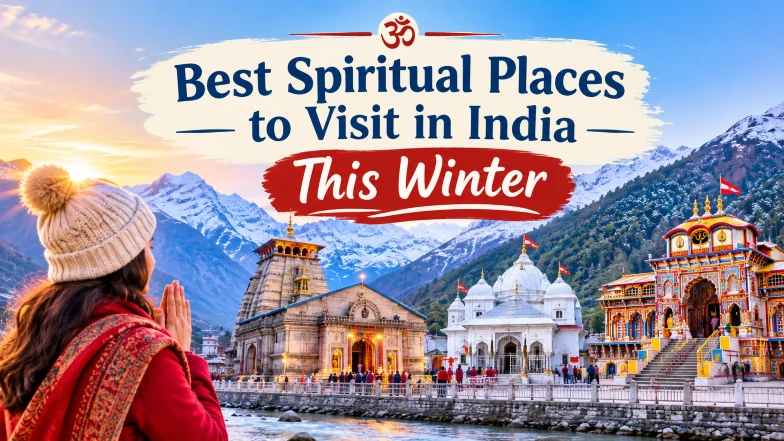
As the season changes, the best spiritual places to visit in India will provide a certain calm that you can experience on the spot. The air holds a fresh crispness, people are fewer and temple bells ring a bit clearer in the cool morning haze. When you want to travel for more than sightseeing, it’s the time of year to do so.
Many of the world’s oldest spiritual traditions can be found in India. It has been influenced by Hinduism, Buddhism, Sikhism, Jainism and Sufism. Whether one goes on pilgrimage from the ghats of the river Ganga to the golden sanctum of Amritsar, or from quiet monasteries of Bihar to sea-facing temples of the south, there is a pilgrimage for all the seekers.
Most of these places are also most enjoyable during the winter months (November through February). Long queues at the temple can be tiring in the summer and the monsoon can make travelling difficult. During the wintertime, the ghats can be walked at a time of day when the sun rises, and one doesn’t need to squirm in discomfort through lengthy rituals for many hours, and can explore on foot without melting by the time the sun reaches noon.
This guide presents the most spiritually enriching destinations in India for the winter season, highlighting the unique qualities of each location, what you’ll find there, and helpful tips for a peaceful and spiritual trip.
What Makes a Place Spiritual in India?
Spirituality is not limited to temples in India. Usually, a sacred place is one that is held special because of a legend or historical event. Others have a river, a mountain or a sea that people have worshipped for centuries. Some believe there is spirituality just by the people who come together there every day to chant, meditate or serve others.
When deciding where to venture, consider what you want to experience. Ritual and devotion, quiet meditation, history or community service? You will be carried off to very different places with your answer. Those who love ritual will prefer to stay at Varanasi, those who love stillness will prefer to stay at Rishikesh, and those who value seva (selfless service) will prefer to stay at Amritsar.
Why Winter Is the Best Season for a Spiritual Trip in India
To appreciate the importance of timing for a spiritual journey, it is necessary to know how and why it is important before the destinations.
Comfortable weather:
A lot of the cities of the plains and the south have favourable temperature conditions between November and February. This makes long walks, early morning rituals and outdoor ceremonies a lot more enjoyable.
Auspicious dates and festivals:
Important events pack in during the winter season. Varanasi welcomes the onset of Dev Deepawali in late November, Amritsar is awash with Gurpurab, Makar Sankranti and Pongal come in mid-January, and Magh Mela at Prayagraj immerses the Sangam in devotion from January into February.
Improved access to sacred areas:
The crowds are not as large as they are on the summer holidays, so it’s easier to find a quiet moment in a temple or on a riverbank.
Good conditions for meditation and yoga:
Sitting practice is best done on a cool morning and many ashrams run their longest and most structured programs in the winter months.
The one point to note is that all the high Himalayan shrines are closed during the winter. After the autumn season Kedarnath, Badrinath, Gangotri and Yamunotri close their gates and Hemkund Sahib remains under snow. All the destinations below are open and at their best during these months.
Want to plan your trip around the month of December? Read our guide on the Best Places to Visit in India in December 2026 for more travel ideas.
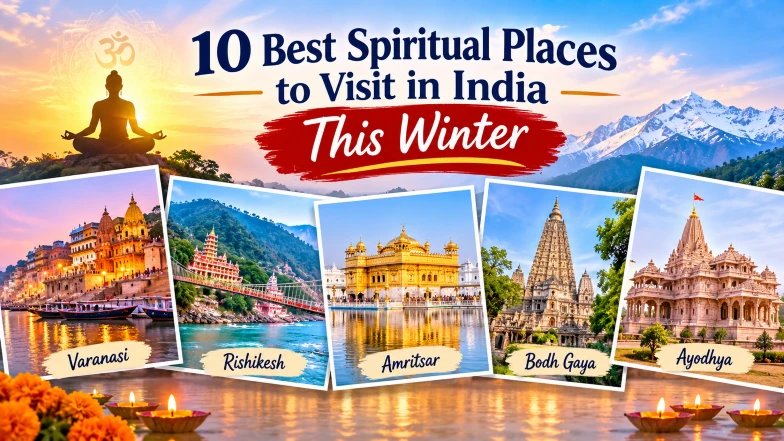
10 Best Spiritual Places to Visit in India This Winter
1. Varanasi, Uttar Pradesh: The Eternal City
Many travellers would agree that if they’re only going to visit one spiritual destination in India, it should be Varanasi. It is also known as Kashi and is one of the oldest continuously inhabited cities in the world, and is known as the holiest city in Hinduism.
What to do
- Experience the sunrise on the Ganga (River) with a boat ride, as the river turns orange and the ghats slowly come alive.
- Enjoy the evening Aarti (ritual ceremony) at Dashashwamedh Ghat, where the lamps are lit in sync with the chanting, incense burning and other rituals.
- See the Kashi Vishwanath Temple, which is one of the 12 Jyotirlingas dedicated to Lord Shiva.
- Stroll through narrow lanes surrounding the ghats and stop at Assi Ghat for a more relaxed night-time scene.
- Visit Sarnath, where the Buddha gave his first sermon.
Why winter works. The river seems to be a mirage on a misty morning, and on Dev Deepawali, the full moon of the Kartik month in late November, each ghat becomes a sea of earthen lamps.
Tip. Book your boat rides and hotels in good time for Dev Deepawali, as the city gets crowded quickly.
2. Rishikesh, Uttarakhand: The Yoga Capital of the World
Rishikesh has been attracting sages, seekers and musicians for decades, since the Ganga leaves the foothills of the Himalayas and goes down to the plains. If you’re looking for a spiritual experience in yoga, meditation and quiet reflection, this is your best option.
What to do
- Take part in yoga or meditation at any of the numerous ashrams found along the river.
- Go across Laxman Jhula and Ram Jhula, the famous suspension bridges.
- Go for evening aarti at Triveni Ghat or Parmarth Niketan.
- Take a trip to the Neelkanth Mahadev Temple in the forests above town.
- Just sit on a sandy bank of the Ganga for one hour.
Why winter works. The days are mild and sunny, the nights are cold, and it’s a true Himalayan getaway. For a portion of the year, white-water rafting shuts down, giving the town a more peaceful and thoughtful period of the year.
Tip. Bring warm clothes for early morning and late evening hours since it cools down quickly when it gets dark.
3. Amritsar, Punjab: The Golden Temple Experience
No place in the country is as warm and welcoming as the Golden Temple, or Harmandir Sahib. Its gleaming sanctum, reflected in the Amrit Sarovar, is one of the most photographed and most moving sights in the country.
What to do
- Consider visiting the Golden Temple early in the morning or late at night when it is quieter, and the reflections will be at their finest.
- Enjoy the continuous kirtan (devotional music) that fills the complex.
- Eat in Guru Ka Langar, one of the world’s biggest community kitchens, which feeds thousands of people daily.
- Check out Jallianwala Bagh and the Partition Museum for historical context.
- Experience a different form of energy, a patriotic one, at the Attari-Wagah border, and watch the Beating Retreat ceremony.
Why winter works. On cool days, it’s easy to walk about the marble parikrama barefoot, and in winter the sanctum is softly lit by fog. In November, Gurpurab (the birth anniversary of Guru Nanak) is celebrated with processions, lights and special prayers.
Tip. Cover your head, take off your shoes and wash your feet before entering. Head coverings will be available at the entrance.
4. Bodh Gaya, Bihar: Where the Buddha Attained Enlightenment
The most significant Buddhist pilgrimage place in the world is Bodh Gaya. Under the Bodhi Tree here, Siddhartha Gautama achieved enlightenment, and the Mahabodhi Temple complex, a UNESCO World Heritage Site, commemorates the location.
What to do
- Relax in the quiet near the Bodhi Tree and Mahabodhi Temple, particularly early in the morning.
- See the Great Buddha Statue, which is 80 feet tall.
- Visit monasteries created by the Buddhist communities from the Tibetan, Thai, Japanese, Bhutanese and Myanmar communities.
- Enjoy a short meditation session at one of the meditation centres.
- Pass through thousands of prayer flags, and hear the low chants.
Why winter works. It is the time of the year when the Buddhist pilgrims are at their peak. Monks from all parts of the globe come here, and the Kagyu Monlam, a major prayer celebration, typically occurs in the winter season, lending an international and piety-laden ambiance.
Tip. Temple hours are limited and security is tight, so be sure to carry a valid ID and refrain from carrying large bags.
5. Ayodhya, Uttar Pradesh: The Birthplace of Lord Rama
In recent years, Ayodhya has emerged as one of the most popular pilgrimage sites. It is considered to be the birthplace of Lord Rama and is revered by people from all over the country, and its infrastructure has been enhanced a lot.
What to do
- Visit the Ram Mandir and schedule your darshan time in advance, as there may be limited slots available.
- Enjoy a peaceful stroll along the ghats of the Saryu River, particularly at dawn and dusk.
- See the Hanuman Garhi temple, located at the top of a hill with steps leading up to it.
- Visit Kanak Bhawan and other temples dotted in the old town.
Why winter works. Walking around temples is far better in the cooler times of the year, and long queues for darshan are much easier to endure without the summer heat.
Tip. Please check the booking and entry guidelines for darshan before travelling, as they change with time.
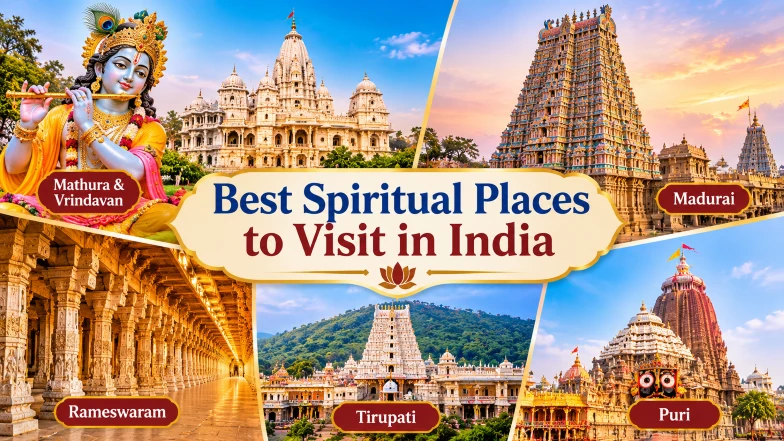
6. Mathura and Vrindavan, Uttar Pradesh: The Land of Krishna
Mathura and Vrindavan are twin towns and there is a lot of devotion to Lord Krishna. You’re greeted by the sound of chanting, bells and the words “Radhe Radhe” on almost every street.
What to do
- Visit the Krishna Janmabhoomi in Mathura, the traditional birthplace of Lord Krishna.
- Visit the grand Banke Bihari Temple and the ISKCON temple in Vrindavan.
- See the evening aarti at Vishram Ghat on the bank of the Yamuna.
- Take a stroll through the ancient lanes lined with small shops selling prasad, sweets and devotional items.
- If you can do the long walk, visit Govardhan Hill for a parikrama.
Why winter works. The mornings are cold and the weather is comfortable for long visits to the temple. The winter season is peaceful and auspicious for devotional chanting and satsang.
Tip. Take extra precautions with valuables in heavily frequented areas of the temple, and lock valuables at your hotel.
7. Madurai, Tamil Nadu: The Temple City of the South
Madurai is one of the earliest cities in South India and the centre of it is the grand Meenakshi Amman Temple. Its vibrant gopurams are adorned with thousands of painted images, and the entire complex appears to be a living work of art.
What to do
- Explore the Meenakshi Amman Temple, with its Hall of a Thousand Pillars and the sacred Golden Lotus Tank.
- Attend the nightly ritual in which the deity is taken in procession to her bedchamber.
- Pay a visit to the nearby Thirumalai Nayak Palace.
- Savor some of the traditional South Indian cuisine in the temple streets, such as idli, dosa and of course the famous jigarthanda.
Why winter works. Tamil Nadu enjoys the best weather during the months of December to February, with pleasant weather throughout the day and cool nights. Pongal in January brings colour and festivity to the region.
Tip. Be sure to wear modest attire and remember that mobile phones and cameras are not permitted in the main temple.
8. Rameswaram, Tamil Nadu: Where Land Meets the Sea
Rameswaram is located on an island on the outskirts of India and its importance is due to its association with the Ramayana. It is one of the Char Dham pilgrimage places and is also the location of one of the twelve Jyotirlingas.
What to do
- See the long corridors of the Ramanathaswamy Temple, among the longest in India.
- Have a ritual bath in the 22 sacred wells (theerthams) within the temple.
- Visit the ghost town of Dhanushkodi at the end of the island, where the sea feels endless.
- Cross Pamban Bridge, an engineering landmark with views of the water on both sides.
Why winter works. The humidity and heat subside in these months, and the numerous rituals and temple walking become easier to handle.
Tip. If you intend to take ritual baths, wear light, fast-drying clothing and carry a change of clothes.
9. Tirupati, Andhra Pradesh: The Abode of Lord Venkateswara
The Tirumala Venkateswara Temple, on the hills near Tirupati, is one of the most visited and richest temples in the world. The experience is on a large scale, but is highly organized.
What to do
- Book your darshan appointment online in advance with the temple trust.
- In addition, walk up the Alipiri footpath, the traditional path that is followed by the pilgrims.
- Visit the Sri Padmavathi temple at Tiruchanoor.
- Enjoy the popular Tirupati laddu prasad.
Why winter works. The hill climate is cooler and more comfortable, and the walk up the steps is much easier in winter.
Tip. Make sure to book darshan weeks in advance, and steer clear of school vacations and weekends, which result in longer lines.
10. Puri, Odisha: The Home of Lord Jagannath
Puri is one of the four sacred Char Dham sites of the country and is home to the grand Jagannath Temple. The town is both deeply spiritual and easy-going, with a seaside feel.
What to do
- Visit the Jagannath Temple (entry is restricted to Hindus) and, if you are not Hindu, watch the practices from outside.
- See the sunrise over the Bay of Bengal at Puri Beach.
- Visit the UNESCO World Heritage Site Konark Sun Temple for a day trip.
- Try the Mahaprasad, which is an auspicious food cooked in the temple kitchen.
Why winter works. The sea breeze is light, the days are sunny and the coast is at its best. It is also the perfect time to enjoy a nice long beach break along with the pilgrimage.
Tip. Stay close to the beach for convenience, but be alert to the crowd around the temple on auspicious days.
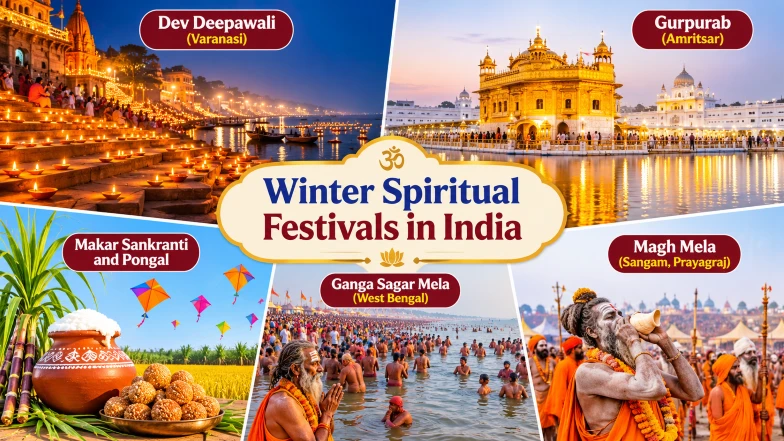
Winter Spiritual Festivals in India You Should Not Miss
Visiting a festival at the right time can make your trip memorable.
Dev Deepawali (Varanasi, late November):
On the full moon of Kartik, lakhs of lamps are lit on the ghats.
Gurpurab (Amritsar, November):
The Golden Temple is illuminated and processions and continuous prayers are held.
Makar Sankranti and Pongal (mid-January):
Harvest festivals are observed with rituals, kites, sweets and temple visits throughout the country.
Ganga Sagar Mela (West Bengal, mid-January):
People come together to take a dip in the Ganga River at its juncture with the Bay of Bengal, for religious purposes.
Magh Mela (Sangam, Prayagraj, January-February):
A month-long pilgrimage event of sadhus and satsangs as well as ritual bathing.
The dates for festivals are based on the lunar calendar, so please check the days nearer to your travel date. Plan ahead; accommodations near the large event venues sell out weeks in advance.
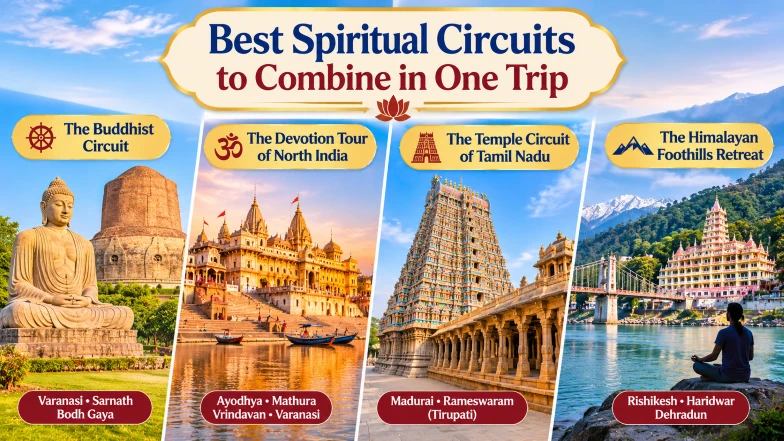
Best Spiritual Circuits to Combine in One Trip
A pilgrimage will be more rewarding if you visit places in groups rather than crossing the country.
The Buddhist circuit
Varanasi, Sarnath and Bodh Gaya are on the trail of the Buddha from his first sermon to his enlightenment. Make plans for six to seven days.
The devotion tour of North India
Ayodhya, Mathura and Vrindavan, plus Varanasi, is an abundant itinerary involving the tales of Rama, Krishna and Shiva.
The Temple Circuit of Tamil Nadu
Madurai and Rameswaram are within easy reach of one another and represent the finest of Dravidian temple architecture. If there is more time, add Tirupati.
The Himalayan foothills retreat
Rishikesh is a perfect match for yoga, aarti and quiet walks along the riverbanks with Haridwar and Dehradun.
Planning more than one trip this winter? Read our guide on the Best Places to Visit in Rajasthan in Winter and plan your next getaway.
How to Plan Your Spiritual Trip in India This Winter
A good pilgrimage is not about the number of places visited. There are some simple practices you can get into that will help make the trip easier.
Book early
During winter the trains fill up and so do the darshan timings at popular temples. Be sure to plan 4-6 weeks in advance for major festivals.
Group places by region
Make a trip to Varanasi, Sarnath, Bodh Gaya and Ayodhya all in a single go or make a southern circuit trip to Madurai, Rameswaram and Tirupati. This will minimize travel time and expenses.
Dress modestly and comfortably
At the majority of temples, cover your shoulders and knees, and wear shoes that are easy to slip off. Bring socks to use on cold marble.
Prepare for chilly mornings
In the south mornings can be cool. For the northern regions, include a warm jacket, shawl and woollen socks.
Travel light and respectfully
Please respect local traditions and refrain from loud voices in sacred places, and take photographs of people or rituals with their permission.
Leave room to rest
The best moments happen by chance: a meeting with a priest, an hour of quiet on a ghat or a cup of tea with a stranger.
Final Thoughts
Spiritual travel in India does not mean checking out temples. It’s about slowing down enough to sense yourself in places that have been places of devotion to humans for thousands of years. The best time to do just that is during the winter months, which boast mild temperatures and plentiful festivals.
The places are all different, be it the lamp-lit ghats of Varanasi, the peaceful ashrams of Rishikesh, the humble langar of Amritsar or the Bodhi Tree of Bodh Gaya. Choose the one that resonates with you, travel with few belongings and enjoy the process.